DEV BLOG / 25
Rebalancing the business of a franchise
A long career needs an economy that carries its bills forward without losing the team underneath them.
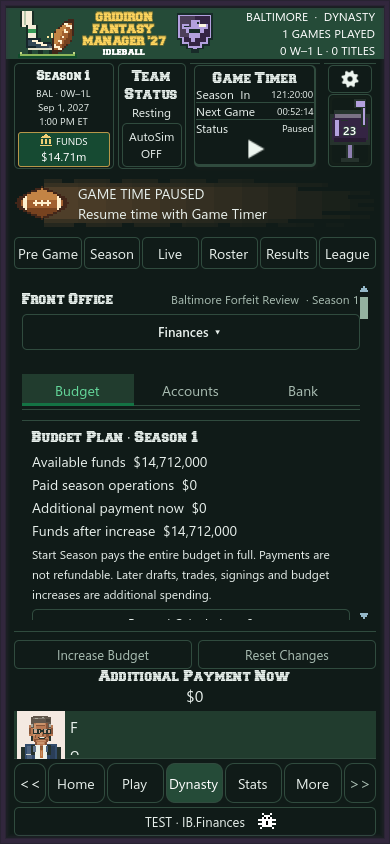
Game screenshots
The record books and Yearbooks give a long career more meaning. The finances need to let that career continue for sensible reasons, and end for sensible reasons when it goes wrong.
I’ve been revisiting the economy. That includes where money comes from, when it is committed and what happens when a new balance rule meets an existing save. My bourbon knowledge remains considerably more polished than my accounting vocabulary, but the money still has to add up.
What changed since the records and presentation work
- National and local funding are independent. Their contributions can be understood separately instead of hiding inside one unexplained total.
- Championship rewards have a defined place. Recognition and franchise income need to agree with the recorded result.
- Opening capital and operations were rebalanced. A new franchise needs its initial commitments shown clearly.
- Training and stadium investments were reviewed. Their costs and benefits have to fit the rest of the management choices.
- Suite and gate accounting are more explicit. Income should have a route back to the part of the franchise producing it.
- Loan, budget and trade settlements retain their meaning. Moving money doesn’t silently rename the transaction or lose an obligation.
- AutoSim recruiting and contracts respect full-depth affordability. A club needs a legal roster it can support, not just an impressive first signing.
- Retirement and New Game+ carry real franchise state. Finalized statistics and the successor transition need to preserve the history.
- Previously paid commitments and assets survive. Existing saves, trophies, facilities and settled obligations don’t disappear because I changed a cost rule.
A rebalance shouldn’t erase last season
If the franchise has already paid for something, the next version needs to recognise that payment. If it owes money, that obligation needs to remain visible. The manager shouldn’t have to guess whether a balance adjustment has rewritten the past.
Joe’s financial help has a role here: explain the shortfall, point to the budget or bank, and use a valid quote. His retirement or bankruptcy farewell should use the actual career totals and explain what the transition means for the franchise.
A projection isn’t the whole test
I can inspect the formulas and run focused checks. A long live career still has to demonstrate that the pieces hold together over time. I’m keeping that work open rather than treating a plausible spreadsheet as the final verdict.
I want the interesting decision to be whether to pay for a veteran, improve a facility or accept a weaker season while the team grows. I don’t want the interesting decision to be guessing which number on the finance screen is trustworthy.
There’s progress, and there’s still balancing to do. Next week I’m gathering the interface corrections around this work and the shared packages built from the same checkpoint.
How the screens have changed
Screens from this development build.