
DEV BLOG / 05
Turning the engines into a franchise management game
The league works. Now I need the decisions around it to be worth making.
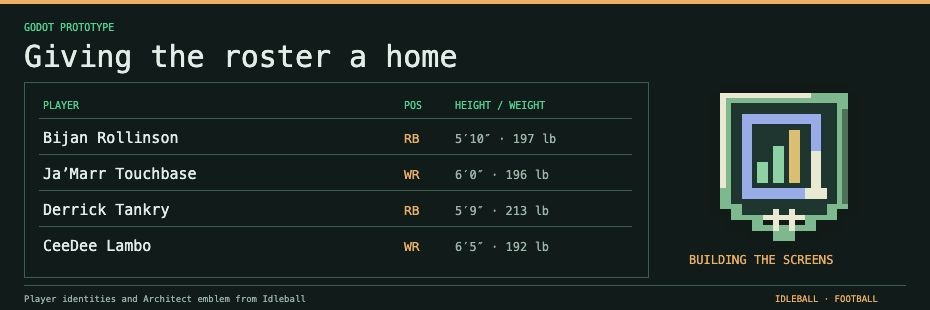
Drawing the players gave the roster some personality. The next problem was giving me a reason to make choices about that roster.
I don’t want a management game where you pick the highest number on every screen and then wait. Depth, condition, money and the kind of football you want to play all need a say.
What changed since the portrait experiments
- The roster expanded to twenty places: nine starters and eleven reserves, with visible vacancies and legal preseason cuts.
- The founding draft grew with it. Twenty rounds supply the larger roster; older saved drafts retain their original round counts.
- Condition has a place in preparation. Fitness, fatigue, morale, leadership and chemistry sit alongside ability.
- Scouting follows the actual upcoming class. Research reveals information about the prospects you’ll later draft; confidence doesn’t improve their talent.
- Trades can involve several players and cash. Roster legality, medical status and future cap commitments are checked before confirmation.
- Contracts share the franchise’s money. Payroll, scouting, construction and trades draw on a common bank, with guarantees, bonuses, options and release costs to consider.
- Results have somewhere to live. Box scores, play logs, team-by-season careers, archived rosters and record books preserve the consequences.
Five ways to prepare the team
The pregame styles are Balanced, Ground Control, Vertical Passing, Conservative and Defensive. Those are broad plans, with different relationships to opponents and facilities. They aren’t the individual Power, Finesse and Read contests inside a simulated play.
A roster should make me think about which plan suits it. That’s more interesting than treating every running back as an interchangeable parcel with a salary attached.
Scouting has a similar purpose. Paying to learn more about a prospect should reduce uncertainty. It shouldn’t improve him because I stared at his profile particularly hard.
Making a decision stick
A trade proposal and a completed trade are different things. So are an estimated salary and the amount actually committed. I’m putting checks and confirmations around those boundaries because a management game can do plenty of damage with an enthusiastic button.
There’s still balancing to do. I’m not claiming the perfect economy has emerged from my spreadsheets. I’m saying the pieces now interact, which gives me something much more useful to work on.
The next chapter moves into the front office: messages, construction and a calendar that remembers what I’ve agreed to.